













.png?width=397&height=365&name=CPDmember%20(1).png)
 Firntec Building Safety (Wales) Act – Webinar Q&A" />
The Building Safety (Wales) Act will introduce significant new responsibilities for building owners and managers in Wales, and with implementation dates approaching, many building owners and dutyholders are still seeking clarity on exactly what the new requirements will mean in practice.
At Firntec, we recognise that periods of legislative change can create uncertainty. Our role is to help organisations understand what is required, identify any gaps in their current arrangements and help prepare them for the new regulatory landscape. Following our recent Building Safety (Wales) webinar, we received a number of questions from attendees looking for further guidance. In this article, we cover off the questions raised and provide practical insight to help you navigate the changes ahead.
1. Does this apply to commercial properties?
A reasonable sample depends on the building size, occupancy, and risk. For residential blocks, typical guidance is 20–25% of flats for inspection of occupied areas in Type 3 or 4 FRAs, focusing on representative layouts, construction types, and potential high-risk areas. The assessor should document rationale for the sample chosen.
2. Does the concept of an Independent Section (outside the HRB) exist as in England?
No, Wales does not recognise “independent sections” in the design and construction HRB regime.
%20Bill%20-%20June%202026%20-%20Webinar%20Screenshot%20(2).png?width=920&height=473&name=Ventro%20Firntec%20-%20Building%20Safety%20(Wales)%20Bill%20-%20June%202026%20-%20Webinar%20Screenshot%20(2).png)
3. In the picture of the buildings, why is the top left picture not taking into account the floor under ground?
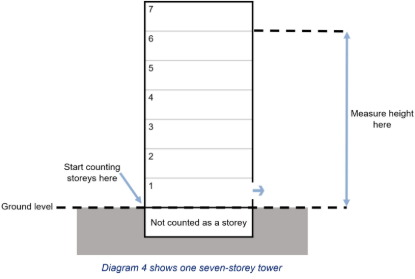
The diagram does not count the underground floor because storeys that are entirely below ground level are not counted when determining whether a building is a higher-risk building. In Diagram 4 of the GOV.UK guidance, only storeys above ground level (plus any storey at ground level) are included in the storey count for HRB purposes. A basement or lower-ground floor that is wholly below the surrounding ground level is therefore excluded from the count. This is why the top-left example does not treat the underground floor as an extra storey. Criteria for determining whether a new building that is being designed and constructed is a higher-risk building.
4. What is the current timeline of implementation for registration?
- Design & construction regime: from July 2026
- Occupation regime rollout: from 2027 onwards
- HRB registration expected: late 2027
5. I have had a couple of issues whereby we need to evidence building construction. The building manual is missing foundation and floor slab details. The building is showing no distress and does not warrant opening up for a condition perspective. I am waiting outcome from Home Ground as to whether they are satisfied. What is your opinion given we are duty bound to give factual information.
Given the duty to provide factual information, the safest position is to state clearly that the original records are incomplete, set out what evidence is available, and avoid assuming unseen foundation or slab details. If there is no visible distress and opening up is not justified on condition grounds, that can be recorded as an observation, but it is not a substitute for missing as-built evidence.
%20Bill%20-%20June%202026%20-%20Webinar%20Screenshot%20(3).png?width=917&height=462&name=Ventro%20Firntec%20-%20Building%20Safety%20(Wales)%20Bill%20-%20June%202026%20-%20Webinar%20Screenshot%20(3).png)
6. Is there consideration for emergency work regarding the notifications etc? as like in England.
Yes, emergency work is allowed where urgent risk to safety exists, e.g.:
- Structural damage
- Fire safety failures
- Dangerous services
Please note that this cannot be used to avoid the gateway application process or to avoid dealing with the relevant regulations. Often Emergency works can only be used for a small amount of work such as fitting a replacement window and not to replace all the fire doors in your HRB as an example.
7. Everywhere I have read has indicated that there are 66,630 building across the 3 categories. Is this an accurate number?
The 66,630 figure appears to be an estimate used in Welsh Government policy material for buildings across all 3 categories, rather than a fixed live count. It is best treated as an indicative estimate, not a precise confirmed total, unless a newer official statistical publication confirms otherwise.
8. Is the application to hospitals similar to that in England in that the Act only applies during design and construction and do the building categories throw up any other variances?
Yes, this is broadly similar to England in that hospitals fall within the higher-risk building regime for design and construction. In Wales, the occupation regime under the Building Safety (Wales) Act 2026 is focused on multi-occupied residential buildings, so hospitals are not brought into that occupation regime in the same way.
9. Why do we feel there is such a large range of potential HRB's, and why there was so many more identified in England than expected? I always assumed this to be more regulated and precise.
The range is large because identifying HRBs depends on applying legal definitions to real building stock, which is often inconsistent in height records, storey counts, use, mixed use layouts, and later alterations. England also found more buildings than first expected because once registration and review processes began, more buildings met the technical criteria than had been captured in earlier estimates.
%20Bill%20-%20June%202026%20-%20Webinar%20Screenshot%20(8).png?width=912&height=459&name=Ventro%20Firntec%20-%20Building%20Safety%20(Wales)%20Bill%20-%20June%202026%20-%20Webinar%20Screenshot%20(8).png)
10. As FRAs now legally have to be conducted by a competent person in Wales and as the Act has been enacted, do I need to update my FRA within 6 months of April 2026 for an in-scope building?
Not automatically on a 6-month trigger purely because April 2026 has passed. Fire risk assessments in Wales must be suitable, sufficient, carried out by a competent person where needed, and reviewed when no longer valid or where there has been a significant change. If the building has changed, the risks have changed, or new legal duties affect the adequacy of the existing FRA, then it should be reviewed and updated without waiting.
11. But the fitting of a temporary door - may not have the full fire resistance intended as an "official door! - will this fall under an equivalent Mandatory Occurrence Report due to potential for escape of smoke and flame?
Potentially yes, if the temporary door creates a fire safety risk that could lead to serious harm, particularly through the spread of smoke or flame. Whether it is reportable will depend on the threshold in the mandatory occurrence regime, so it is less about the door being temporary and more about whether the temporary arrangement creates a sufficiently serious building safety risk.
12. What are the requirements for projects that are non-HRBs? Are principal contractor and designer functions still required like England?
The dutyholder regime applies to all notifiable building work, not just HRBs. Roles such as client, principal designer, and principal contractor still apply HRBs simply introduce additional controls (e.g. gateways, approvals).
We would like to thank everyone who attended our recent Building Safety (Wales) webinar and those who took the time to submit questions. The volume and quality of the discussions highlighted just how much interest there is in the new legislation, but also that many organisations are still seeking clarity on what the changes will mean in practice as the implementation dates approach.
The questions raised during the session reinforce the need for continued education, guidance and industry collaboration to ensure building owners and dutyholders are fully prepared for the new regime. At Firntec, we are committed to supporting organisations through this transition, helping to provide clarity where uncertainty exists and offering practical advice that enables confident decision-making. If you have further questions about the Building Safety (Wales) Act or would like support preparing for the changes ahead, our team is here to help.